I ask my self this question probably more than any other question fishing related through the winter months, I would say a lot of anglers might do the same. Now another season is upon us for Brown Trout fishing on our lakes and rivers and the competition dates are rolling in. I make the usual personal promises to my self to try harder this year and improve on my efficiency when competing. The lessons taught to me through the tough sessions last season should be all addressed and corrections made to ensure those simple errors I made wont be the reasons for bad scores this time around and man o man I did some learning last year.
For me I spend a lot of time during the winter months analyzing my approaches, techniques, set ups, organisation and making adjustments to improve all of the same; I theorize this as 'systems and processes'.
I have found through many years of learning from fly fishing and in particular competition fly fishing that it is very beneficial to break down all aspects of your fishing and take every detail in to consideration to aid your efficiency and performance, let me explain about my fore mentioned theory.
Process are aspects of your fly fishing approaches that all add up to the holistic way you fish, so for example processes can be wading, casting, nymph presentation, hooking fish, landing fish, organizing of your chest pack or wading jacket, beat management, among others. In order to complete and process you have a system to do it, even if you haven't recognized it or think about it you do.
For example the process in which you put on your waders has a system, you put them on by putting you feet in to the neoprene sock, for some the first thing is to put on woolly socks first then into the waders followed by then putting on your boots and lacing them up, then you clip the belt or put on your brace ect. If you think about it there is a individual system there we all use to complete the process, though it might not be the same for everyone but a system all the same.
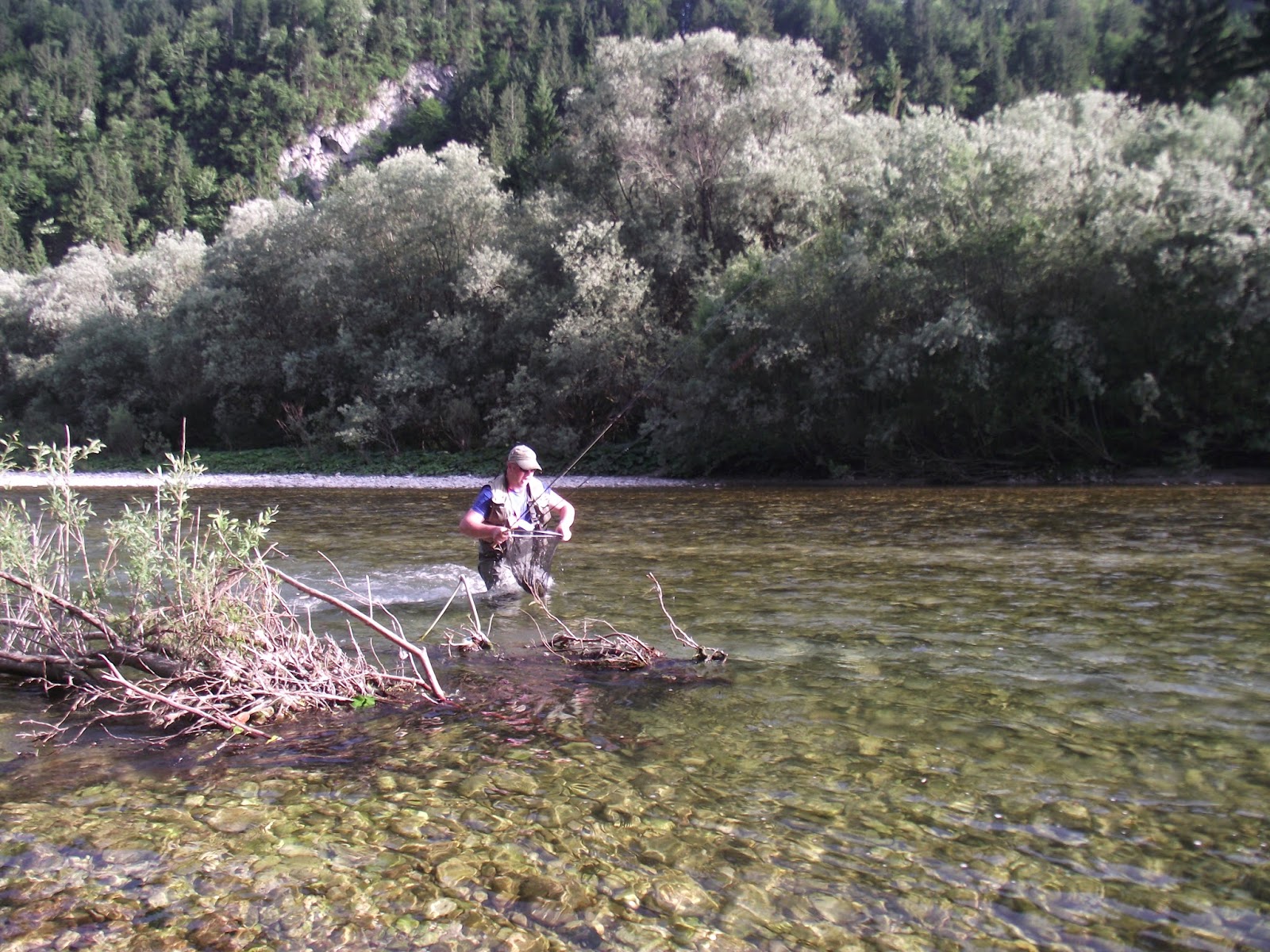
Lets look at some of the systems that I have tended to focus on over the last few winters, netting fish and presenting them to a controller is a process and when it is broken down into the systems I can then make adjustments to be more efficient and be more in control when completing the process, ie landing and handing the fish to the controller and getting back out to catch more.
Here are some point I considered for this:
- What netting material my net is made of ,will my nymphs get caught up when a fish is landed thus slowing me down when I go back out fishing. I either buy or make a net to prevent my nymphs from getting tangled up.
- I also added a 20 cm piece of coloured fabric into the base of the net so any fish I am sure dose not make the size I don't have to make the journey to my controller to find out it is short.
- Is how I hang the net on me in an efficient manner, is my magnet strong enough so the net does not keep falling off my back, is the handle in a accessible location and in the same place every time so I know where it is and I don't have to reach for it allowing me to present my net to a hooked fish quickly and effortlessly.
- Is the handle long enough so when I am netting a fish do I have to reach or stretch to it depending on my leader length. I measure from my rod hand to the hooked fish and ensure the handle is long enough and I have a mark on either my line or leader so when it reaches my casting hand I know the fish is at the right distance to be netted and I am not reaching with either hand and run the risk of losing the fish.
All these potential issues I would consider when looking at my netting process and make the necessary adjustments to the systems in advance so the frustration of time loss and dropping fish due to bad netting practice in a session is at a minimum.
Another area I have spent some time pondering over is the process of casting nymphs, accuracy, keeping contact at all times and presentation of my nymphs.
A lot of anglers use the popular brands of nymphing leaders and they are very successful on them, but for me I like to be a bit more three dimensional with my leader systems to try and improve the processes mentioned before.
I make my own leaders for several reasons to improve this process:
- I can use formulas to build the leader that suits the way I fish, cast, reach and strike fish.
- I can put extra spring in the leaders by boiling them to allow me fish lesser diameters with fewer break offs and makes the leader more supple.
- I can again make different leaders up not just for lengths but also some more aggressive and progressive than others to aid my casting in different conditions.
- I can add in what I call a locator section up the leader firstly to train my eye to find the thin indicator immediately and secondly to allow me to fish different depths as I make my way through the beat, using the locator as the indicator when I move into deeper water.
These are all points that I have put in place to make the process of casting and contact much more effective when I am nymphing. Another important component to this process is of course the rod and for me I like to have a soft and the lightest possible rod I can get. This with the spring in the leaders and good contact with the nymphs allows me to fish confidently with 0.08 tippet and therefore have the potential of catching more fish.

Also I have considered the process of carrying my gear around with me on the river, I use a chest pack so when I am moving about everything is tied up neatly; it used to drive me crazy when I wore a vest and it was swinging all about with tippet spools and zingers going all over the place. I also spent some time thinking over my fly boxes and organized them in my chest pack. I know exactly where every nymph or dry is so I waste no time looking for what I need at anytime and with some adjustments made to the pack i am able to carry two made up rods that don't interfere with me fishing or casting.
Some people or actually a good few people think I am a bit mad but for me I enjoy analyzing all the different aspects of my fishing and making improvements in areas that I feel I need it. For me this important to evolving as an competitive angler and there are always improvements we can make in our process and systems we use to fly fish, I also find it very enjoyable when I see the results of the changes I make and I have eliminated one of those annoying things that keep happening during my time on the river. Of course we cant always get it right and some things are out of our control, but we can remove some of the issues that arise through this thought process.
I never pretend to know a lot about fishing, and I have a lot to learn yet through the lessons handed out by the rivers and fish we search for, but have I always believed that if you focus on the smallest details and make improvements as part of your learning then all those small details will add up to extra fish on your card.
If you have now joined the group of people that think I am a little cracked then well and good, but I do hope you can take some understanding from this post on looking at different, small aspects (systems) of you approach to the process you use in you fishing and begin to see the results.
When I am asked to give some pointers to someone on fly fishing or competition fishing the three most important words I say are: Details...Details....Details

 I begin by placing in the vise a Dohiku 611 size 16,14, 12 depending on the size of the caddis in the river, this nymph is on a size 16. With a 2mm copper bead I tie in some fine clear mono and olive body stretch.